What Makes an Executive Résumé Different From a Mid-Level Résumé?

Posted by & filed under Uncategorized.

Is an executive résumé simply a mid-level résumé with a more impressive title and a higher salary?

Absolutely not.

Both résumés must demonstrate accomplishment, credibility, relevant experience, and professional value. The difference lies primarily in scope, perspective, and level of impact.

A strong mid-level résumé generally needs to answer questions such as: What can this person manage? What functional expertise does he or she bring? What problems can this individual solve? What projects, people, customers, processes, territories, technologies, or responsibilities have been successfully handled?

As professional responsibility increases, however, the lens begins to widen.

An executive résumé must increasingly demonstrate not merely what the candidate managed, but what the candidate influenced.

Did this executive shape organizational direction? Improve profitability? Lead transformation? Build or restructure organizations? Develop markets? Direct large-scale operations? Create strategic partnerships? Influence boards or senior stakeholders? Establish culture? Develop other leaders? Navigate significant risk or change?

An executive is ordinarily being hired not simply to perform within an organization but to affect the organization itself.

That requires a different writing perspective.

For example, a mid-level operations manager might appropriately emphasize improving productivity within a department, reducing operating costs, managing a staff of 40, and implementing a new process.

An executive presentation may need to move farther upstream: Why was the operational transformation necessary? How broadly did it affect the organization? What financial, competitive, customer, or strategic result followed? What other divisions or leaders had to be brought together to accomplish it?

The résumé therefore begins to demonstrate leadership through scale and consequence.

Executive positioning also requires judgment about what not to include. A highly accomplished senior professional can easily produce pages of impressive history. Yet if every accomplishment receives equal emphasis, the most important accomplishments disappear in the crowd.

Writing an executive résumé therefore requires selection as much as expansion.

The question becomes: What does this particular executive want the reader to understand about him or her after two minutes with this document?

Operational authority? Growth leadership? Turnaround expertise? Innovation? Financial stewardship? Organizational transformation? Market expansion? The ability to build extraordinarily effective teams?

That central professional identity should influence what receives emphasis throughout the résumé.

There is another important similarity, however. Whether I am writing for a mid-level professional or a senior executive, I still return to accomplishment.

Titles alone do not create value. Responsibilities alone do not create differentiation.

What did you do with the responsibility you were given?

That question matters at every professional level.

The mid-level résumé demonstrates the ability to perform, manage, advance, and deliver results within an area of responsibility.

The executive résumé must additionally demonstrate the ability to lead beyond that immediate area—to influence direction, organizations, people, markets, and results on a larger scale.

The résumé grows more sophisticated as responsibility grows, but the fundamental principle does not change:

Show me what you were trusted to do—and then show me what happened because you did it.
Why the Résumé Interview Still Matters in an AI and ATS Hiring World

Posted by & filed under Uncategorized.

The technology surrounding the hiring process has changed dramatically. Applicant Tracking Systems organize applications, search résumés for qualifications and keywords, and help employers manage enormous volumes of candidates. Artificial intelligence can now assist with recruiting, candidate screening, résumé preparation, and job-search strategy.

All of that is significant.

But none of it eliminates the need to first create a résumé worth finding.

We sometimes become so focused on getting a résumé through a system that we forget what must happen when it comes out the other side. Ultimately, we are still trying to introduce one human being to another and give an employer a compelling reason to begin a conversation.

That is why I continue to believe so strongly in the résumé interview.

A good résumé interview is not simply an information-gathering exercise. I am not merely asking where someone worked, when they worked there, and what duties they performed. Much of that information is already sitting in front of me.

I want to know what happened because they were there.

What problems did they inherit? What did they initiate? What did they improve? Who relied upon them? What was particularly difficult? Where did they save money, generate revenue, retain business, build relationships, solve problems, improve systems, develop people, or influence outcomes?

Frequently, my clients struggle to think about their careers in those terms. Some of the most talented and innovative professionals I have worked with are surprisingly at a loss for words when it comes to describing what they actually do, what distinguishes them, or what value they have brought to an organization.

That is where collaboration becomes so important.

I remember working with a client who held a Ph.D. in Mechanical Engineering. During our interview, he asked me what I knew about MEMS technology.

“Very little,” I told him truthfully.

“So how can you write about something you don’t understand?” he asked.

I responded, “What do you know about MEMS technology?”

“Everything,” he answered.

“Well,” I told him, “because I listen attentively and ask insightful questions, I can write over my head. I can translate what you tell me into relevant messaging for your marketplace.”

When I finished his résumé, he asked me, “How could you write so scholarly about something you didn’t understand?”

I told him, “There really isn’t anything on that paper that you didn’t actually tell me. But the collaborative writing process can be almost magical.”

He couldn’t get over it.

That experience illustrates something I have witnessed repeatedly throughout my writing career.

An insightful question may trigger a memory. A memory may reveal an accomplishment. That accomplishment may uncover an unusual gift, talent, or professional strength the client has never thought to articulate.

Almost magically, an accomplishment or career transition that looked obscure on paper begins to make perfect sense when we understand its value, relevance, or transferability.

A skillful résumé writer can bridge the gap between where a client has been and where that client wishes to go. Through interviewing, writing, and collaboration, we can translate those discoveries into language and keywords that Applicant Tracking Systems can recognize without reducing a human career to a haphazard collection of keywords.

That becomes even more important in an age of generative AI.

Technology can produce polished language remarkably quickly. But polish alone does not create credibility, individuality, or professional distinction. Well-placed words are not enough—if they ever were.

The résumé must sound credible because it is credible.

It must connect responsibilities with results, characterize strengths without exaggeration, and help the reader understand not simply what a candidate has done, but what that person may be capable of doing next.

ATS strategy matters. AI matters. Keywords matter.

But none of them negate the value of asking the right question, listening carefully to the answer, and translating discovery into a true characterization of a client.

That is where some of the best résumé writing begins, because a résumé can only be as good as the story—and the professional—behind it.

How AI Has Changed Résumé Writing — and What It Still Can’t Discover About You

Posted by & filed under Uncategorized.

Artificial intelligence has unquestionably changed résumé writing. It can organize information, suggest stronger language, identify repetitive wording, compare a résumé with a job description, and present familiar information from a different perspective. Used judiciously, it can be an impressive writing and research tool.

But there is an important distinction between working with information and discovering information.

AI can work remarkably well with what we give it. Still, it cannot know what we have forgotten, undervalued, or are simply unable to articulate. That distinction becomes enormously important in résumé writing.

Most of my clients do not easily think in terms of professional accomplishments. They know what they do, but they cannot always make the connection between what they do, its value, and its impact on projects and organizations.

They may remember that they managed a department but not readily verbalize their influence on the team under their charge. They may characterize themselves as troubleshooters or problem solvers without recognizing how those abilities translated into tangible achievements such as effecting business turnarounds, penetrating new markets, redesigning operational processes, improving quality, reducing costs, or increasing productivity.

I have often found that even highly gifted and talented professionals undersell themselves and underthink what they have actually accomplished.

That is where the collaborative interview becomes a critical catalyst in helping them tell their story.

If AI simply makes up the missing pieces, it may produce impressive fiction, but it will not produce an authentic characterization of the professional behind the résumé. Writing in the absence of discovery cannot fully differentiate an individual or present that person as distinctly as he or she deserves to be presented.

AI can ask questions, but asking questions and making meaningful human discoveries are not necessarily the same thing. It cannot know from the information supplied what a client has forgotten, minimized, failed to recognize, or casually dismissed as insignificant.

After preparing 12,000+ résumés, I have repeatedly found that some of the most valuable information emerges only through the interview process—asking questions that provoke thought, awaken memory, and bring a client’s story to life.

AI cannot independently remember an achievement its user has forgotten. It cannot see the hesitation in a client who says, “Oh, that really wasn’t anything,” when in fact it was quite something. It cannot instinctively recognize that the accomplishment being casually dismissed may be precisely what differentiates that individual from competing candidates.

Nor can technology completely replace judgment.

A résumé is not improved simply by making every sentence sound more impressive. Overselling can be every bit as detrimental as underselling. The art lies in discovering what is genuinely valuable and presenting it with confidence, accuracy, perspective, and restraint.

AI can certainly assist in that process. I use technology and appreciate what it can do. But I believe the strongest résumé begins in the collaborative writing process. It begins with the story behind the résumé.

Career history is as individual as a fingerprint. Technology may help us organize, refine, and articulate that history, but the questions, reflection, collaboration, and human insight that uncover its most valuable pieces remain profoundly important.

AI can help us say something better. The greater challenge is discovering what needs to be said.

That is precisely where a collaborative and insightful résumé writer can discover, synthesize, and articulate who you are—and transform the raw material of a career into a distinctive professional presentation rather than merely an AI-generated document.

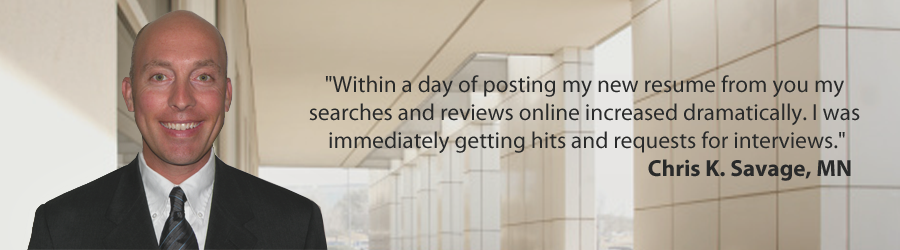
Chris K., Savage, MN

Professional Résumés that Perform in the Marketplace

Posted by & filed under Services.

Chris came to me with a résumé that he felt wasn’t performing. When I reviewed it, I could understand why. He obviously was a talented professional, but his résumé wasn’t demonstrating his value.

I often say that if we were comparing a résumé to geometric principles, we would say the cover letter and qualifications profile are the theorem and the content of the résumé is the proof. In a cover letter, I endeavor to articulate a client’s special gifts and talents. In the résumé, I make sure that we prove what we say with substantial résumé content. In this way, we intrigue a prospective employer with a real-world story and with what I call the recurring theme of a résumé.

Read more »

Is a chronological résumé versus a topical résumé the best strategy?

Posted by & filed under Resume Strategy.

People often wonder if they should use a topical rather than a chronological résumé and ask if I can prepare a topical or  (functional) résumé for them. But is that the best strategy? Of course, having written thousands of résumés, I can do so. But before I do, I like to share a few insights with them.

Most people want to use a topical résumé because they basically want to hide something. They may feel they changed jobs too often. They may feel they don’t have any experience in their area of new interest. They may be unsure of what they want and wish to cover all the bases.

Read more »

Discovering Our Natural Gifts and Talents.

Posted by & filed under Inspiration.

I believe that all of us are richly endowed with natural gifts and talents. Isn’t it obvious when we sit in a performing arts center and listen to a voice like that of Pavarotti or Sarah Brightman? These are people who discovered and used their gifts to bring joy to others, and ironically, they have been well paid for doing what they love so much.

As I have worked with thousands of clients, I have been struck by the reality that most people are reluctant to recognize their gifts and talents, and even if they do, they are very hesitant about verbalizing what they are. It has given me a deep sense of career gratification to help people identify and give life and voice to their professional gifts and talents through the power of the written word.

Before we can become ready to “sell” others on the idea that we can be a true asset to their company or team, we must go through this process of self-discovery and subsequently practice the art of letting ourselves know what we know. It reminds me of an Arabian proverb:

He who knows and knows not that he knows—he is asleep; wake him.
He who knows not and knows that he knows not—he is simple; teach him.
He who knows not and knows not that he knows not—he is a fool; shun him.
He who knows and knows that he knows—he is wise; follow him.

I love reminding my clients that it is all right to allow ourselves to know what we know and to use our gifts to lead others who do not. It’s not bragging to admit that we excel at something if we really do. We certainly don’t try to pass ourselves off as knowing everything. Who does? But when we do know, when we have the skill, or when we do have the answer, we need to give ourselves permission to present ourselves unhesitatingly to those who are searching for qualified people.

Have you ever met a salesperson who really didn’t have their heart in their product? How did you feel when they presented it to you? Isn’t it true that you can’t inspire others to share your belief, confidence, and enthusiasm unless you yourself have it first? So the first sale has to be the sale of you to yourself. You have to know what you know and be excited about your ability to share that with others.

I have a friend who says, “Shoot from the heart and you’ll never miss.” If we do this in our professional lives, we won’t miss either!

Acceptability Versus Unacceptability in our Interview Process

Posted by & filed under Inspiration.

What Is Acceptability Versus Unacceptability in Our Interview Process?

What is it about an interview that connects with all the youthful messages we carry about acceptability versus unacceptability? Somewhere in time, someone indelibly impressed on our souls that, as we lived our academic lives, there was some kind of transcript of life we were recording with every missed class, unfinished assignment, or lesser grade. Whoever it was that articulated that message—a well-meaning parent, a threatening teacher, an ambitious counselor, or one of the ever-elusive definers of success—the stage was set. We were programmed to think that our imperfect life would somehow need to be defended in almost every place. Why didn’t we finish college? Why did we stay in school so long? Why didn’t we get better grades? Why weren’t we able to get along better with people? And on and on.

I can’t tell you how many clients have entered my office with all those fears and damages foremost in their minds. “I have three degrees but have never had a decent job.” “I never went to college. I’m afraid they will think I’m a professional student.” “I went to college for three years and never got my degree. I’m afraid they will think I’m a quitter.” “I’m too young. I have no experience. I am afraid no one will want to hire me.” “I’m 50 and I’m terrified that I won’t be hired because of age discrimination.”

As I listened to and attempted to comfort my clients, I came to a profound realization. We all have things in our past—unfinished academic business, job choices, job losses, or things that make us feel unacceptable. And the good news is, no one has it all or can present the perfect record! So let’s get down to the basics of presenting what we do have to offer! The person who is a professional student has a marvelous education to put on the table. He needs to recognize and promote that! The woman who went to school for three years and did not finish needs to realize that she has three years of college education to her credit. The young graduate who lacks experience has a wondrous youth, new ideas, endless energy, and trainability! The 50-year-old has precious experience to share!

My oldest client was 84 years old when we did his résumé! He came to me one day and said, “Retirement has never been for me. Do you think I’m still marketable?”

As I spoke with this man, I realized that he was a fantastic forensic specialist with unique voiceprint expertise. He had been hired by prosecuting attorneys and testified in trials as an expert witness in voice recognition.

I said, “Mr. D, how many people can do what you do?”

He said, “There aren’t many with expertise in the field of voice identification.”

“Then you have 60 years of experience to offer. You are sharp as a tack, and there is certainly a market in law enforcement for what you have to offer. But there are also young, upcoming professionals who would probably pay to have even the smallest portion of your knowledge and field experience.” At the time, he was still going strong!

So we come to the job interview with the backdrop of our past, with this “transcript” that we think we created. We may feel defensive. So it becomes our task somehow to prove our acceptability to the person who sits on the other side of the desk. Because we need and want a good job, our worthiness somehow appears to be defined by whether we can articulate our worth to the hiring manager or HR professional who has the power to hire or dismiss.

So our first preparation for the interview is to work at quieting those old voices, to somehow take back our power, because the interview is not the definer of our acceptability. An interview is simply a mutual exploration process, an effort at determining whether we can meet a company’s needs and whether they can meet our expectations. If we can somehow disarm that “unacceptability landmine,” we can free ourselves to enter into that mutual exploration process without becoming devastated if we don’t fit their profile. And too often, we don’t even consider the other side. What if they don’t fit ours? What if we see things in the interview about company policy, protocol, or even their management philosophy that give us warning messages that we would not want to work for them?

My point is simple. The interview is a two-way street. It affords us an opportunity to present who we are and what we have to offer and, in turn, to explore how a company operates and what, if anything, they have to offer us. When there is a common meeting ground between both parties, a wonderful working relationship may come to be. Our ability to handle interviews with this attitude is a skill we must develop. It may not come in the first interview. It may not come in the tenth interview. But we only need one job. So what is it worth to try to find the right job—a job that makes us feel happy to go to work, a job that allows us to feel that we are making a contribution?

Our first step to finding that kind of opportunity has to begin with our ability to disarm our unacceptability button and open ourselves to a two-sided exploration process!

How Much Should You Invest in Your Résumé?

Posted by & filed under Inspiration.

People often wonder how much they should invest in their résumé.

In harder times, we are forced to cut back and analyze every purchase we make. The question is, can we afford to cut back on our advertising, our résumé, and our outreach to the marketplace? Can we afford to cut back on the key to securing and increasing our earnings?

The cold, hard reality is that, in a competitive job market, employers can afford to be selective. This means that competition for any position can be intense, and our need to differentiate ourselves can be equally strong. It follows, then, that our investment in our résumé may be more mission-critical than ever.

So let’s think about the cost of your résumé. I have a friend who is a really gifted fisherwoman. She proudly displays all of her lures, and the bigger the fish she’s after, the more expensive the lure she uses. Everybody wants the best job and the highest possible wage, but when it comes to a résumé, some argue, “I can’t afford to spend money on a professional résumé.” The reality is that it can be too costly not to invest in a quality résumé.

I have come to call résumés our “passport to the marketplace.” We understand that if we want to travel and leave the country, we must have a passport, whatever it may cost. A quality résumé is no different. A distinctive résumé should tell your story and showcase your best talents and accomplishments. It should never read like a cut-and-paste version or a simple job description. I often tell my clients that when résumés tell a story, they often reflect a recurring theme, much like the recurring theme in a score of music that captivates and impels us to purchase a new song. Similarly, I am always pleased to find that, when allowed the luxury of taking the extra time required to write the highest-quality résumé, a recurring theme emerges that shows the gifts and talents of my client. And that recurring theme proves that, unlike a “hole in one” shot on a golf course, these gifts and talents are characteristically evident throughout a client’s career. If we are in sales, and our skills lie with building trust and relationships, the recurring theme will reflect many new and profitable accounts and long-term client retention. If we are operations managers, the recurring theme will be continuous improvements, cost savings, and innovative systems and enhancements.

It follows, then, that the more time we spend crafting your résumé and telling your story, the more impact your marketing vehicle will have. While a one-page résumé may be appropriate for some entry-level candidates, experienced professionals often need more space to present the accomplishments and qualifications most relevant to an employer. Of course, it takes time to tell that story, and the more time we invest, the more expensive the résumé will be. But put as much into telling that story as you can, because the rewards will be commensurate with the impact of that story.

A résumé is an important investment, but it should fit realistically within your budget and the level of support you need. Remember, there are hidden costs to résumés that people don’t often consider beyond the initial investment. There is the expense of buying résumé books, taking résumé-writing courses, only to find later that these have not yielded the superior result you hoped for. Unfortunately, this approach is much like a car owner trying to take an auto-mechanic course to save money on car repairs. It takes years to acquire the highly specialized skills and diagnostic equipment to do so! How much better to do what we do best and leave the repairs to the experts.

Then there is the cost of putting an ineffective résumé into the marketplace: the lost time and wages, not to mention the psychological impact of rejection letters or, even worse, no interviews. Often, when clients have sent out hundreds of self-created résumés and been confronted with no results for months, they call me in despair to tell me their résumé is not working. By this time, their self-esteem is seriously decimated, and they are convinced that they are just not marketable! And that is a really unfortunate stance from which to seek a quality position.

It reminds me of a story that Og Mandino tells in his book, The Greatest Salesman in the World. In training his salespeople, he says he always gives them a crisp $100 bill to place in their wallet and instructs them never to spend it. And then he explains why. He tells his salespeople that when they are about to close a sale and they feel desperate, he wants them to remember that they have that $100 in their wallet, because “a desperate salesman never sells.”

Likewise, I never want my clients to feel so badly about themselves when they finally do get an interview that, like that desperate salesperson, they can’t sell themselves. Instead, try to address that desperation at the outset, if at all possible, by going out to the market with the best possible presentation. If you are already feeling unmarketable, bolster your confidence with that new presentation and remind yourself that the past does not equal the future.

To borrow the wisdom of my friend with the fishing lures, if you want the best-paying jobs and cream-of-the-crop interviews, you need to invest in the best possible marketing tools. While it is always good to watch your budget and carefully separate needs from wants in a troublesome and challenging economy, your résumé is too important for compromise. That’s why I tell my clients that even in the leanest times, I never fail to invest in my advertising, because no matter how fine a writer I may be, I will be the best-kept secret in the world if my market doesn’t know I exist!

Remember the old adage, “You get what you pay for”? The converse is also true. You also get the best possible positions and the best possible pay with the best possible presentation. Invest as much as you can in getting the very best quality marketing tool, and you will get the best possible returns. Remember, there are still jobs out there to be had, and you only need one of those jobs! It follows, then, that if you put your chips on marketing yourself well, you will be able to survive and even thrive in today’s challenging marketplace.

Is Interview Frequency or Customer Traffic a Measure of Talent?

Posted by & filed under Inspiration, Interview Tips.

In slow times, we may be tempted to wonder if our interview frequency or customer traffic is a measure of our talent.

My daughter is an entrepreneur and a talented, gifted artist, and I am a professional writer. Often, I remark on how God gave us different gifts so that we could help one another. On good days, when business is booming and we are in high demand, we feel validated in our professional roles. But on quieter days and in slower times, doubt can cast a shadow over our self-belief and sense of reality.

It reminds me of what a young man who was repairing my TV once said to me. “I always marvel,” he said, “at how everybody needs me at once or doesn’t need me at once.” From a business owner’s perspective, I found this to be quite hilarious, but I also immediately grasped his point.

Once, in our travels out West, my husband and I were looking for a quaint restaurant. We spotted a lovely little Mexican restaurant. It had charm and curb appeal, but there were no cars in its parking lot. We pondered a bit, wondering if that was an indicator of its quality, but then we decided to give it a shot.

When we entered the restaurant, we were immediately captivated by its compelling cultural ambience and décor. The customer service was exquisite, and the cuisine was tantalizingly off the charts! Afterward, we couldn’t help but reflect on the experience we would have missed if we had followed the “no traffic” diagnostic approach. The fact is that we had encountered a fantastic restaurant during off-hours, and its lack of traffic had nothing to do with the lovely experience that beckoned to outsiders who would dare to chance an entrance through its elegant and ethnically decorated doors.

My daughter and I often discuss this phenomenon and remind each other that whether we are overwhelmed with business or in “off hours,” we are still the same talented people. Or, put another way, our talent isn’t fairly measured by our traffic.

And the application for my clients is the same. When we have a job, we feel that our worth is validated. We feel in control. We feel that we are valuable. Conversely, when we do not have work, the terror moves in, and we worry about whether we’ll ever find a job. Often, we correspondingly lose our sense of self-worth. Yet, it is precisely at such times that we must challenge ourselves to remember that our talent and our value are not related to our customer traffic or our employment status. Our value is a constant that never changes. Nonetheless, the outside world can distort our reality by its acknowledgment or lack of acknowledgment. So use your talent to find work in off or down times, and leverage it to serve your clients’ or employers’ needs well in those much easier-to-bear, high-demand times!

Use Relevant Keywords and Navigate Applicant Tracking Systems

Posted by & filed under Resume Strategy.

Keywords help establish the relevance of your résumé and improve the likelihood that Applicant Tracking Systems will interpret your experience accurately.

Applicant Tracking Systems help employers collect, organize, search, and review applications. Once associated primarily with larger companies, they are now widely used across organizations of many sizes. Because these systems may search résumé content for relevant skills, qualifications, and terminology, clear structure, appropriate keywords, and ATS-compatible formatting have become increasingly important.

Relevant keywords can help both Applicant Tracking Systems and human readers recognize the fit between your experience and the position you seek. When a particular job is in mind, language from the posting can be incorporated where it genuinely reflects your background and qualifications. I do not believe, however, that a résumé should have to be rebuilt for every opening. A strong résumé should already contain the terminology that accurately reflects your profession, skills, accomplishments, and experience, while the cover letter can accentuate the qualifications most relevant to a specific opportunity.

My clients often ask how we can be sure that the right keywords will be included in their résumé. I tell them that many of the strongest keywords and skill sets flow naturally as they tell their professional story. A Core Competencies section can identify concrete areas of expertise they have acquired. Terms such as Customer Service Management, Relationship Management, Sales & Marketing, Cross-Functional Team Leadership, and Performance Management can become meaningful keywords because they describe real areas of professional capability. By contrast, phrases such as “team player,” “reliable and dependable,” or “able to work independently or in groups” are generic and offer little differentiation. When we purchase an automobile, we don’t ask whether it has a steering wheel. We assume it does! Likewise, an employer expects a quality candidate to be reliable, dependable, and capable of working with others. The résumé needs to tell the reader something more meaningful—what kind of professional you are, what you bring to the table, and how you have demonstrated those strengths through accomplishment.

While graphics, tables, text boxes, and multiple columns may be visually appealing, they can still create problems for some Applicant Tracking Systems. A clean, readable, single-column format remains the safest approach when a résumé will be submitted through an online application system. Important information should also be kept out of headers and footers whenever possible.

File-format requirements vary, so always follow the employer’s instructions. Both PDF and Word documents are commonly accepted today. If no format is specified, a well-prepared PDF generally preserves the résumé’s appearance, while a Word document may be requested by some systems or recruiters. Whatever format you use, review the uploaded résumé carefully to make sure the text has been interpreted correctly.

In conclusion, I remind my clients not to become overly anxious about keywords. Every profession has its own characteristic language and terminology. As you collaborate with your writer, many of those terms will emerge naturally, and a skillful writer can help integrate the terminology that is relevant to your profession without forcing keywords where they do not belong.

If you focus on telling the best of your professional story, articulating meaningful accomplishments, and using a clear ATS-compatible format, your résumé can be both keyword-rich and compelling to the human reader who ultimately receives it.

Choose your writer well, and he or she can help you tell your professional story in a way that satisfies the technology without sacrificing the individuality, accomplishments, and professional value behind it.

What Makes a Distinctive and Impactful Résumé?

Posted by & filed under Resume Writing.

A well-performing résumé must be distinctive, impactful, and accomplishment-focused. Résumés have evolved from simple employment summaries into professional marketing presentations designed to communicate value, credibility, and fit within a competitive marketplace.

A résumé can no longer function as a simple job description. It must be an accomplishment-rich presentation that showcases the best of your skills and talents. Résumés do not perform well when they are superficial or filled with fluff and grandiose statements. A quality résumé should offer substantial content that demonstrates what you have done, how well you have done it, and the value you have delivered to your employers.

Most people are very adept at doing their jobs and often at a complete loss when it comes to describing their work or accomplishments. I sometimes tell my clients that attempting to write their own résumé can be like trying to perform self-surgery or sew a garment on themselves while wearing it. It can be a daunting challenge. Part of the difficulty is that we naturally view our own experience from the inside out, while a skilled résumé writer can bring an outside-in perspective. We must remember that our reader knows nothing about us until we tell them. And when we tell our story, we must frame it in a way that brings the reader into our experience without leaving them to fill in the blanks or expecting them to know what we have not yet told them.

With 25+ years of professional résumé and business writing experience, I have developed a high level of expertise in interviewing and collaboratively writing with my clients. Often, they think they do not have enough of a story to fill even one page. I remember a senior executive who came to me with two small 3 x 2 Post-it notes and asked if I could make a résumé out of them. I replied, “I can if you interview with me for an hour to an hour and a half.” By the time we concluded the interview, he was amazed by how much rich and compelling content we had uncovered—and by how much of a story he really had to tell! That kind of discovery, transforming overlooked experience into meaningful, quality-focused content, is what a differentiating résumé is all about. I have done it for professionals from every walk of life and at every professional level.

If you would like to discuss your résumé and career goals, contact Nadine for a free consultation. She will personally review your needs, help you identify the résumé package and strategy that best fit your situation, and provide prompt, professional service tailored to your objectives. Packages are available for entry-level, mid-level, executive, and senior-level professionals, with 24-hour service available when needed.


Collaborative Writing – A Vital Résumé Writing Tool

Posted by & filed under Resume Writing.

As a professional writer, I discovered early that collaborative writing was a vital résumé-writing tool. When I began résumé writing 25+ years ago, I hired a front-line representative who booked appointments and completed questionnaires with callers. When I tried to write from that material, I realized very quickly that I still had many unanswered questions and needed to interview my clients directly. From the beginning, I learned that the personal interview and collaborative writing process were differentiating résumé-writing tools and methodologies. So I began developing résumé content as I interviewed my clients, creating constructs around their accountabilities and accomplishments.
Read more »

Should You Write Your Own Résumé?

Posted by & filed under Resume Strategy, Resume Writing.

Should you write your own résumé? Today, that question has become more complex. Some people still prefer to write entirely in their own words, others rely on templates, and many now turn to AI tools for help. All of these approaches can assist with organizing information, but none automatically solves the harder challenge of recognizing what is most valuable in your own experience and knowing how to present it effectively to your marketplace.

The résumé-writing craft has changed dramatically. A résumé can no longer function as a simple employment summary listing companies, dates, titles, and job descriptions. It must serve as a professional marketing presentation that demonstrates not simply what you have done, but how well you have done it and what value you have brought to the organizations you have represented.

A professionally written résumé can provide a significant advantage, particularly when a skilled writer brings an outside perspective, asks the right questions, and helps uncover accomplishments the client may have overlooked. A strong résumé must be accomplishment-focused. It must show your value—not only what you have done, but how well you have done it. Quantifying results can be highly effective when meaningful, even when the work itself is somewhat abstract. But ultimately, it is not simply polished writing that makes a winning résumé. It is the content—content that tells your story, showcases your talents, and gives the reader compelling reason to want to know more.

I have a dear friend who is an expert fisherwoman. One day, when she was telling me the cost of her lures, I said, “Isn’t that a lot to spend on a fish who may snatch your lure and not become a catch?” She smiled and replied, “If you want the big fish, you must be willing to spend money on the best lures.”

And that offers an excellent analogy for the value of a professionally written résumé. If you want to compete for the best opportunities, you need to present yourself at your best. Many people are not gifted writers, and even highly accomplished professionals may have difficulty recognizing or articulating the best of their talents, contributions, and accomplishments.

So, before deciding that writing your own résumé—or relying solely on technology—is necessarily the best way to save money, think carefully about what may be at stake. An unproductive job search can itself be costly, and spending weeks submitting applications without generating interviews can be discouraging. A skillful professional writer can help you discover, articulate, and present the best of what you have to offer—and give you the differentiating advantage of a résumé that truly tells your story.


What Makes a Résumé Successful?

Posted by & filed under Resume Strategy.

There are many diverse ideas about what makes a résumé successful. People can be very dogmatic about what to do—and what not to do—when preparing a résumé. There are also many different résumé styles, including chronological and functional approaches. Ultimately, however, the final judge of what makes a résumé successful lies in the perception of our marketplace and the employers we hope to reach.

Read more »

Do I Need to Create a Résumé to Target a Specific Job?

Posted by & filed under Resume Strategy.

People frequently ask me to write a résumé to target a specific job. While some believe this is a viable strategy, it can be a very risky and expensive proposition. Unless a person has had two distinct careers and corresponding experience, it doesn’t make a lot of sense to do this.

The truth is, our story is our story. Our history is our history. When I write for people, I ask them what kind of position they want to pursue at this point in their career. What do they most want to do with that history? Then we collaboratively create bullets that establish relevance between where they are and where they wish to be. We accentuate the segments of their experience that can help a potential employer see them in the role they now wish to play. I have found this to be much more successful than trying to create a résumé to target a specific job by providing only a microscopic view of their experience and talents.

Once we have articulated their story in a résumé, I write cover letters that target the individual opportunities they seek. The cover letter is really the rudder of the ship, and from that perspective, we get the opportunity to tell our audience what a client wishes to do with their experience and how it can be of value to them. When we do that, we give the employer the advantage that one might have in reading an entire book rather than a single chapter. We represent our client in a third-dimensional view with a focus on their transferable skills. But we must show those skills in action, not in theory. Employers don’t want to hire theoretically capable candidates. They want to hire proven talent.

The reality is that the more your audience knows about you, the more they can see your skills and talents through an accomplishment lens. The more likely they are to interview you and explore your value as a viable candidate.

With a few rare exceptions, I find this a more realistic, cost-effective, and successful approach than maintaining multiple résumés. Tailoring the emphasis, relevant keywords, and cover letter for a specific opportunity can be helpful, but a well-developed résumé should present the full strength of a candidate’s relevant experience without requiring a complete rewrite for every opening. When applying for a specific position, the cover letter provides an excellent opportunity to accentuate the qualifications, accomplishments, and experience most relevant to that employer’s immediate needs.

Skiing the Giant Moguls of Unemployment and Career Change

Posted by & filed under Unemployment.

Unemployment can present a daunting, discouraging, and formidable challenge to a job seeker.

As a professional writer, I have had the privilege of preparing 12,000+ résumés for people from every walk of life. Over 25+ years, much of my work has involved helping people pursue better jobs, professional opportunities, and challenging career transitions. Economic conditions may change, unemployment may rise or fall, and opportunities may expand or contract, but when we are personally facing the loss of a job or an uncertain career future, the challenge can feel overwhelming. I have no profound insight into what the economy will do next, but I do have something to say about navigating difficult times.

Read more »

Success Is a Blend of 90% Persistence and 10% Talent!

Posted by & filed under Inspiration.

It occurs to me that although success is truly a blend of persistence and talent, I would rate persistence as a 90% success factor. I say this because talent is like a raw material, a gift that can only be transformed into value by relentless effort, without which there can be neither results nor success.

Have you ever noticed how many brilliant and talented people in the world never seem to accomplish anything, never seem to arrive, and never seem to have a sense of where they are going?

So many people, for one reason or another, are immobilized by fear—fear of failure, fear of facing the unknown, fear of taking the critical steps required to project themselves from the theoretical into the realm of possibility or reality.

The divide between success and failure has little to do with brilliance and everything to do with will and persistence. Have you ever fixed your attention on a child learning to walk? Do they fall and decide that they won’t try again because they fell? Do they somehow conclude they don’t have the “talent” to walk or the same gift that other children have? We smile because we have never met a child who doesn’t keep trying until they learn! Even children without limbs figure out a way to be mobile and to participate in life to the extent that they can. So it is with us. If we don’t have the persistence required to secure a top-notch résumé preparation, to work on our mindset and psychological readiness, and to discover, leverage, and face our market, no matter how gifted we are, we will forever be banned from the realization of our dreams.

There are many unknown inventors and undiscovered innovations because their creators didn’t have the persistence and tenacity required to scale that divide! So how does that translate to marketing ourselves?

It means that we must do everything we can to present ourselves well, to network with others, and to approach anyone and everyone to find our market.

One of my clients had read that it can take many interviews to receive a job offer. So he began looking at each “no” as progress toward a “yes”! What a great idea for harnessing and reversing the force of rejection and turning it into progress toward his goal of a six-figure position.

So once you have done the work of discovering your talents, articulating them in a dynamic résumé, and approaching your market with confidence and conviction, you are ready for the result. One wise sage said, “When the pupil is ready, the teacher appears.” A takeoff on that piece of wisdom might be, “When the seeker is ready, the opportunity appears.” Go out and make those opportunities. Remember, you only need one good job, and the path to success is persistence!

Become a Chameleon in Today’s Job Market

Posted by & filed under Inspiration, Interview Tips.

When I visited Florida, I became fascinated with the remarkable ability of chameleons to adapt their appearance. We can learn from them! It’s not that they become something they are not. Instead, they use resources within themselves to become what they need to be at a given moment. That’s a marvelous lesson for us. We can become what we need to be in a challenging economy.

While you search for your dream job, there are other things you can do. In a storm, we can hunker down in a shelter and wait it out. That may work if we have a shelter. But if we do not, we must create a shelter or find some more immediate form of rescue from whatever we have available to us. We have to use our ingenuity to survive.

There are those who tell us to reinvent ourselves. There is truth in that, but we must be careful how we apply that truth. While taking courses and qualifying for new careers may be a valid course of action for those who have time, others find themselves in need right now. I believe that we have many talents. We have some things we do for work and other things we do for fun. In times of emergency, we may have to transform our hobbies or play activities into entrepreneurial emergency-rescue plans. One mother became a CEO by transforming a hobby of painting birdhouses into a million-dollar production operation. Think of what you do that delights your friends. Remember, you can do more than one thing at a time! Diversify yourself. Become a chameleon as you keep looking for the right job opportunity!

Navigating Career Transitions

Posted by & filed under Inspiration.

Over the years, I have had the privilege of working with thousands of clients who were endeavoring to navigate career transitions—some weary of their career path, others interested in pursuing a lifelong dream, and others still looking for a life change. One young man told me that he had all the accountabilities of a manager without the title. He wondered how he could navigate a transition to the coveted management position he felt he had already earned.

I couldn’t resist quoting Shakespeare. My father loved his work and was always quoting his writings. In Romeo and Juliet, he penned his famous phrase: “What’s in a name? That which we call a rose by any other name would smell as sweet.” So I told my client that he was, in fact, a manager, though he was called by another name. We worked together to create literary snapshots of him doing the work of a manager and showcasing his accomplishments in that capacity. In so doing, we helped his audience see that he had everything but the title.

Sure enough, the young man sent me a letter telling me he had secured a wonderful position and a commensurately rewarding income. Helping our audience see us in the framework in which we need to be seen—painting a portrait of ourselves that demonstrates our capabilities in action—is the best way I know of navigating successful career transitions. Of course, we have to use our legitimate experience. We can’t earn new career opportunities by writing fiction. So we must take our real-life experiences and characterize them in such a way that we help our audience see us fulfilling the very role we wish to play.

You see, somewhere along the way, we were fed the misconception that life is like a geometric path—a road we must flawlessly travel as if we were navigating the shortest distance between two points. But we soon learn that life is full of detours and missed turns that constantly require backtracking, rerouting, and remapping our course. That’s what makes life interesting, fascinating, and adventurous. But when we were in kindergarten, or even younger, someone told us that every move we made in life would make an indelible and unchangeable record that would follow us for the rest of our lives. We were told that we had to go to the right school, choose the right major, take the right job, and pursue an unbroken path to the elusive “success” that we were inspired to seek.

Nonetheless, the reality is that life changes, our interests expand, our talents develop, and everything we do invites us to seek new challenges and change course many times. That’s psychological health—not pathology! I often tell my clients that we must understand that the “gold watch” era is largely past. While our parents and those before us achieved recognition and stature for staying with one company their whole lives, many professionals today change jobs and careers more than once during their working lives. Therefore, the sooner we dismiss this false premise, the more psychologically prepared we will be to reinvent ourselves, present ourselves in the most positive light, and transform our desire for change and transition into an asset instead of a liability!

So transition is not a correction or evidence of a failed course. It is a mark of progression. Everything we have done allows us to bring something new to what we do next. My dad was a printer, and from as early as age four, I have memories of doing small jobs in my dad’s print shop. I was a bindery girl, a typesetter, and later, a press operator. As I used to tell my dad, “I’m still in printing, Dad. I just write it first.”

So realize that every place you have been, everything you have done, however small or seemingly insignificant, adds depth of experience to whatever you wish to do now. Transitions are good! Transitions are possible! With skill, you can navigate change and the career transition you desire and achieve your greater aspirations.

Should Résumés Have an Objective?

Posted by & filed under Resume Strategy.

Years ago, résumé writers routinely crafted objective statements intended to define what a candidate was seeking. Today, the traditional generic objective has largely given way to a professional profile or qualifications summary that tells the employer who you are, what you have accomplished, and what value you bring to the marketplace.

But career direction is more specific. We still need to help an employer understand what we want to do with our experience and how we can bring value in that capacity. The cover letter becomes the ideal forum for defining that direction and connecting our background with the opportunity we wish to pursue.

Maybe we have had both sales and operations management experience. The question becomes: what do we want to do now? If our objective is operations management, we need to show commitment to that direction and give the employer reason to believe we can succeed in that capacity. Accomplishment-focused résumé content, combined with motivational and directional messaging in the cover letter, can help establish that connection.

So, in effect, the cover letter can become our objective statement. It lets the employer know what position we are pursuing and why we are motivated and qualified to pursue it. If we are considering both sales and operations opportunities, for example, we may wish to use two different cover letters, each emphasizing the experience and accomplishments most relevant to that direction. Trying to be all things in one generic cover letter is usually a mistake. Remember the “Jack of all trades, master of none” lesson? If an employer thinks you are presenting yourself as talented in everything, they may conclude that you are truly expert at none.